
November 9, 20265 min read
Start Them Early: What MacKenzie Price's Alpha School Chicago Teaches Every Family
Young people are naturally brilliant. Give them big skills early, make the work feel like a game, and they will be working hard long before they realize it is work. Too often, the thing holding children back is not their ability. It is a schedule built for the average child in a room of thirty.
MacKenzie Price decided not to accept that. Her daughters went from curious to bored at a top-rated school, so the Stanford-trained psychologist co-founded Alpha School in Austin in 2014. This fall she brought the model to Chicago.
Education by the numbers
| Stat | What it means | Source |
|---|---|---|
| 2 hours | Core academics per day at Alpha | Learn 2x in 2hrs |
| 98th percentile | Where tutored, mastery-paced students land | Bloom, 1984 |
| 13% a year | Return on birth-to-five learning programs | Heckman Equation |
| 37% | U.S. 4-year-olds in state preschool (only 9% of 3-year-olds) | NIEER 2025 |
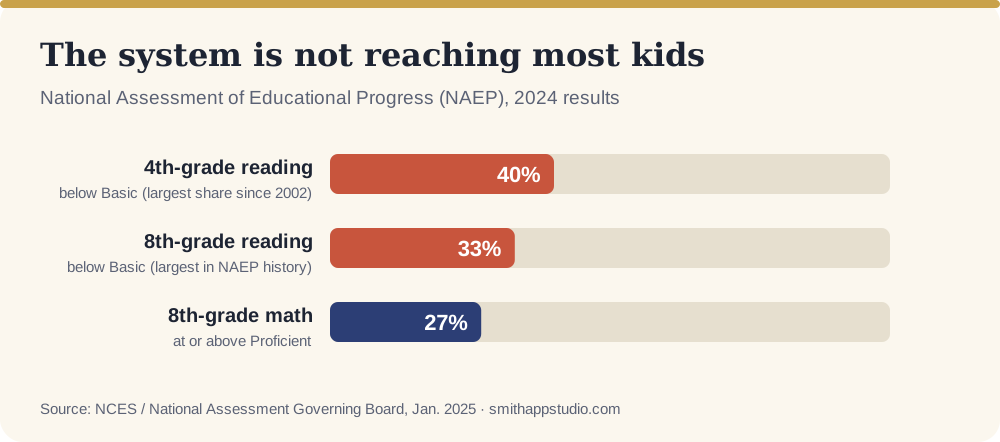
| 40% | 4th graders reading below Basic | NAEP 2024 |
| 27% | 8th graders proficient in math | NAEP 2024 |
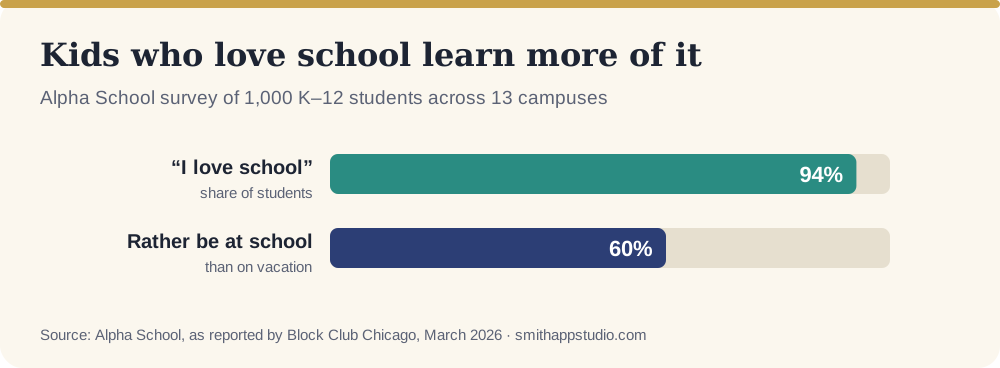
| 94% | Alpha students who say they love school | Love School |
| $55,000 | Alpha Chicago tuition, PreK–8 | Alpha Chicago |
What opened in the Loop
Alpha Chicago opened on September 8, 2026 at 350 East South Water Street. It serves PreK through 8th grade and, according to Block Club Chicago, planned to open with about 100 students. The day splits into two parts:
- About two hours of core academics on personalized, mastery-based software. Alpha's own platform runs alongside programs such as Khan Academy, Membean, Mentava and MobyMax. Alpha explains it on its The Program page. A student moves forward only after showing they have learned the material. There is no homework and there are no textbooks.
- Afternoons of life skills, including public speaking, entrepreneurship, teamwork and leadership, plus financial and tech literacy, all part of Alpha's Life Skills Workshops. Alpha students have run food trucks, given TEDx Youth talks, built apps and managed an Airbnb.
The adults are called guides. Their job is coaching, motivation and support, not lecturing. CBS News went inside one of the campuses to show how it works.
The research is older than the software
The idea of a two-hour academic day sounds new, but its roots go back to Chicago. In 1984, University of Chicago researcher Benjamin Bloom published the "2 Sigma Problem." He found that the average student who was tutored one-on-one, and allowed to master each step before moving on, outperformed about 98% of students in a regular classroom.
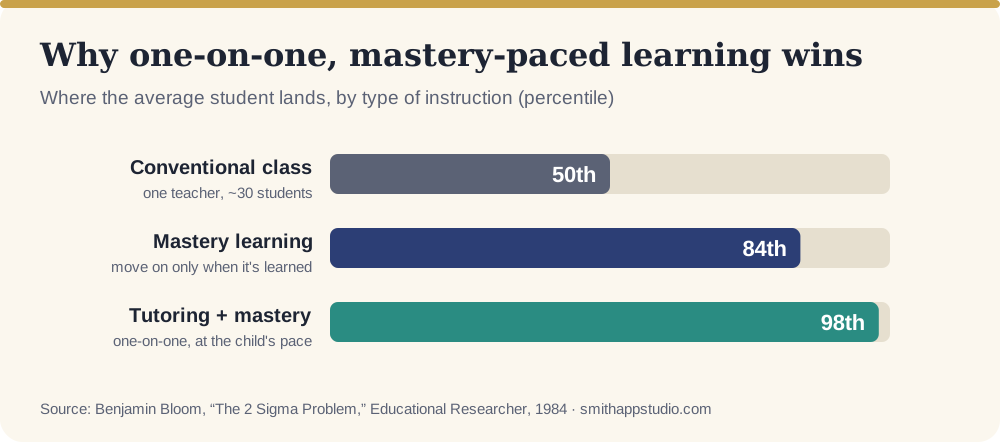
The problem was cost: nobody can hire a tutor for every child. Adaptive software is the first real attempt to give every child that experience. A 2025 randomized trial in a Harvard physics course found that students learned more than twice as much with an AI tutor as in a strong active-learning class, and they finished in a median of 49 minutes instead of 60. The same learning in less time is the core promise of the two-hour day.
Why "early" matters so much
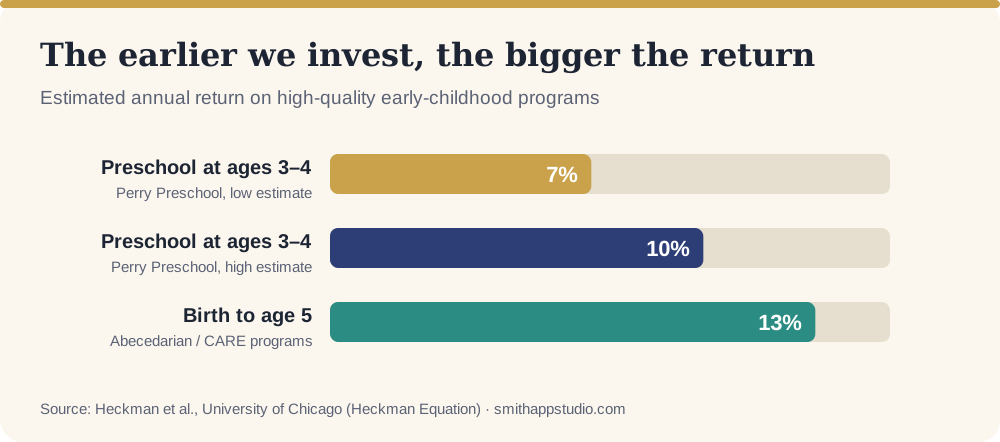
Another University of Chicago researcher, Nobel laureate James Heckman, measured what early learning is worth. High-quality programs that start between birth and age five return roughly 13% a year through better schooling, health and earnings. That beats programs that start at ages three or four, which return about 7–10%.
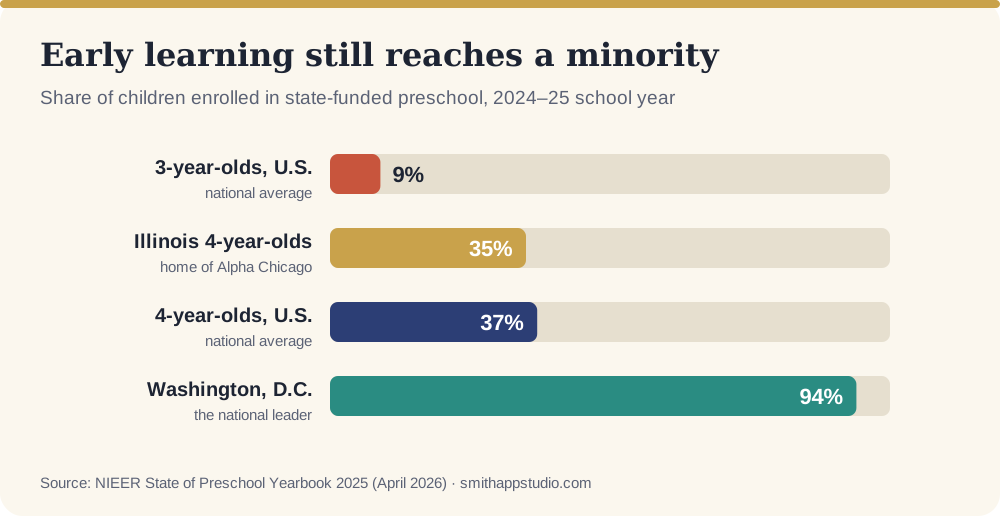
Even so, most young children still miss out. NIEER's 2025 State of Preschool Yearbook found state preschool reached just 37% of 4-year-olds and 9% of 3-year-olds in 2024–25. Illinois reached 35%.
The cost of that gap shows up later. On the 2024 Nation's Report Card, 40% of fourth graders read below the Basic level. Only 27% of eighth graders were proficient in math.
The result we care about most
Grades matter, but loving to learn matters more. In an Alpha survey of 1,000 students across 13 campuses, 94% said they love school, and 60% said they would rather be in school than on vacation.
Alpha reports that its classes score in the top 1–2% nationally on MAP tests. Those numbers are now being examined closely: in October, a New York Times analysis found that 42% of students hit the full "twice as fast" target in both math and reading. That kind of scrutiny is healthy, and it is part of how a bold idea gets better.
See Alpha's programs for yourself
- Alpha Chicago: virtual information sessions on November 11 and 18, a book-a-call link and the Chicago application
- The Program: Love School, Learn 2x in 2hrs and Learn Life Skills
- 2 Hour Learning, the model behind every campus
- Alpha High School for grades 9–12 and Alpha Anywhere for families far from a campus
- Admission, the FAQ, the video library and all locations
Five things your family can borrow tonight
Alpha Chicago's tuition is $55,000 a year. The habits underneath it are within reach of every family.
- Master it, then move on. Don't move to the next chapter because the calendar says so. Move on when your child can answer the questions on their own.
- Practice by answering, not rereading. Pulling an answer out of memory builds learning. Highlighting a page mostly does not.
- Check the answer right away. Feedback the same day teaches. Feedback a week later is mostly noise.
- Protect a short, focused block. Two hours of real focus beats six hours of half attention. Put the phone in another room.
- Give the rest of the day to real projects. Let your child sell something, present something or build something. That is where confidence comes from.
Those first three habits are what ExamPilot is built to run: practice questions that adapt to what a student has and hasn't mastered, instant scoring, and a progress view that shows exactly which topics still need work.
Thank you, MacKenzie
Every child deserves to be taught at their own pace and to spend their afternoons building things. MacKenzie Price is proving what that looks like, one campus at a time.
Our studio, Smith App Studio, has the full story in its Journal, and our sister site Nexaria Digital looks at the young builders those afternoon workshops are creating.
Start building the mastery habit at home with a free account at www.ExamPilot.Help.